• Skip to main content

Jonathan Andersen

A young pastor in an old denomination

  • About

Jonathan

5 things I’ve learned from taking a Sabbath day

My senior year of college the campus ministry I was a part of began encouraging its leaders to take a dedicated time of intentional rest, a Sabbath, each Sunday.

When I heard that some of my friends were doing this, I thought, “That’s great for them. But I don’t have time for a day of rest.” My social life, involvement in clubs on campus, part time job, and academic career kept me extremely busy. And on our college campus Sunday was the day everyone could easily put in numerous hours of uninterrupted academic work at the library. I felt threatened by the idea of taking a day off. I’d lose a day of productivity. I’d fall behind others academically. I’d look lazy. So I didn’t take time for a Sabbath day while an undergraduate.

I was rewarded for all of my hard undergrad academic work with a scholarship to seminary. In one of my first classes there, Introduction to Christian Spirituality taught by Lauren Winner, we talked a lot about the idea of Sabbath. Some budding theologians argued that this intentional time of rest had to be on Sunday as it was put forth in creation and Exodus. Others argued that the pattern of intentional rest called for in the bible could be lived out in chunks of time on whatever day(s) you chose. Either way, while most of us thought about the meaning of a Sabbath, few of us lived it out.

Now I’m serving as an Assistant Pastor at a church. For the first time in my life I’ve begun a regular practice of Sabbath each week. God’s grace and my fear of becoming another burned-out or scandal-ridden pastor helped prompt this change.

Here are some things I’ve been learning in my first five months of Sabbath taking:

1. Sabbath is “a time of being in the midst of a life of doing.”

This line, taken from Awakening Grace, sums up the idea of Sabbath. Sabbath is a time of shifting our attention from everything we are busy doing in the world to being present with God—our creator, redeemer, and sustainer. Being present with God here doesn’t necessarily mean spending 8 hours in prayer. It means living in a way that intentionally reflects who God is, what God has done, and what God will do.

2. Sabbath is a time of being content with God’s sovereignty.

Friday is typically my day of Sabbath. Often this is difficult because there are tasks to be done and sermons to be written. But when I step away from all the work that could be done and rest, it is a living reminder that God is sovereign. I’m able to see more clearly that God’s Kingdom is not going to come about because of my individual efforts. I’m able to see that the church and the world won’t fall apart without me. And these revelations help me to not take myself and my work so seriously that I forget to enjoy God and other relationships that are in my life.

3. Sabbath is a time of being reminded that God loves us without regard to what we accomplish.

In the work place, school, athletic field, home, and church we’re tempted to think that what we do and produce gives our lives their ultimate value. In creating the Sabbath, God reminds us that he is what gives ultimate meaning and value to our lives and this world. When I practice Sabbath, I’m reminded that God’s grace is not something to be earned but a gift to be received.

Martin Luther summarized this well when he said, “The spiritual rest which God especially intends in this commandment is that we not only cease from our labor and trade, but much more—that we let God alone work in us and that in all our powers do we do nothing of our own.”

4. Sabbath is a time of being intentional.

If I didn’t guard my days of rest, then they wouldn’t happen. People try to schedule things on these days and I feel internal pressure to accomplish my undone to-do list. As a pastor whose biggest day of responsibility comes on Sunday, I intentionally wrap up urgent items late on Thursday and push everything else to Saturday. On Fridays, I typically let my body rest by sleeping late—one of my favorite past times. Then I try to do something that energizes my soul like taking photos of nature, exercising, calling old friends, spending time with friends in the area, or exploring the new community I live in.

5. Sabbath is a time of being a witness to a different way of life in the world.

Before this year, I was always envious of people who took a regular Sabbath. I wanted to be able to rest like they were, to trust God’s ways of doing things, and to escape the world that taught me that every second not being productive was a second wasted. I’ve begun to escape, but each week I’m tempted to go back to the place where I was. Often I have to remind myself that I’m being watched as a pastor and that the world is watching us as Christians. When we live a different pattern of life—remembering the Sabbath and keeping it holy—we testify that God has ordered this world, work is not our master, and our lives are not our own.

334263_677629383404_430998078_o
A photo from one of my Sabbath days this summer. Dawsonville, GA

If you’ve ever tried taking a Sabbath, you already know that this pattern of life isn’t easy. We need each other to help live it out. I’m still trying to figure out what Sabbath looks like in my own life. And I hope you will join me so that we can grow together.

What are some ways that you keep a Sabbath?
What have some of your challenges been?

Further resources:

“Sabbath Keeping, it’s about time” – J.D. Walt

“Sabbath” in Awakening Grace – Matt LeRoy & Jeremy Summers – This is a great new book that covers a number of other Christian practices as well.


November 30, 2012 by Jonathan 5 Comments

How do United Methodist pastors end up at their churches?

“How many times did you worship at the church before you went on staff?  Once, twice?” asked a friend the other day.

“Zero,” I replied.

“Huh?”

“It’s a bit complicated, but let me try and explain how United Methodist churches work…”

I’ve had the above conversation many times recently.  Most of my friends from high school and college are members of Presbyterian, Baptist, or non-denominational churches.  Explaining how a pastor ends up at a church in those traditions is similar to how anyone else in America ends up at a job—you’re open for a position, you find openings at churches you’d like to serve, you interview and send in reference materials, a group at the church gives you an offer, and you decide whether to accept or keep looking.

To understand how pastors end up at United Methodist churches, forget all of that.

Churches in the UMC receive new pastors through a system called itinerancy.  Itinerancy is a system of church organization in which ministers are sent to local churches by a Bishop and are regularly rotated from one to another.  Ministers and Bishops are all part of a geographically organized conference (mine is North GA), which is broken down further into districts.  The conference limits where a Bishop can appoint each pastor to serve.

The appointments aren’t random—every year the Bishop and District Superintendents consult with those like me seeking a pastoral appointment and with each church in the conference.  Through much prayer and conferencing, they then seek to determine where to send pastors so that the UMC can best live out its mission: to make disciples of Jesus Christ for the transformation of the world.  The gifts of the pastor, his or her family/life situation, the needs of a local church, the needs of the denomination, and many other factors are involved in the process.

Bishops send pastors to their churches in the UMC
Bishop Mike Watson of the North GA Conference. Photo courtesy of NGUMC.org

Typically, pastors find out where they’re sent via a phone call in the spring.  Some are sent far away, some are sent to a church nearby, and some are asked to stay where they are.  Those moving begin to envision life and ministry at a church they’ve never visited.  One week in June, all the pastors who have been appointed to new churches move and begin ministry at their new churches.  All appointments are made for only a year at a time.  However, the average length of a UM pastor is around four years.  There is also a trend towards longer appointments.  You can read more about the current itinerant system here.

Many Methodist Churches in Britain, Central America, and all over the world continue to use this system that has a historical basis from Methodism’s earliest days.

The UMC website sums up the history well.  “John Wesley began the itinerant system during his work in England. Wesley developed circuits for his assistants to travel, each of which included a large number of appointments. Preachers visited these appointments about once a month and changed circuits from year to year, depending on the current circumstances.”

1839
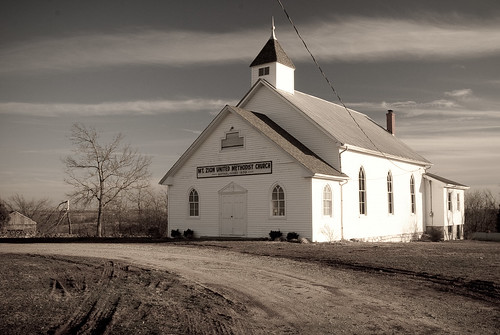
Mt. Zion United Methodist Church. Established 1839. Wilmore, KY.

On American soil, itinerancy adapted to the conditions at hand.  Traveling preachers became known as circuit riders as they rode from one outpost to another helping organize, lead, and perform the sacraments for groups of Christians across the frontier. This system enabled Methodist preachers to reach new settlements quickly.  The rapid growth of Methodism throughout the 18th and 19th centuries in America can be partly attributed to this form of organization.

“We have found by long and consistent experience that a frequent exchange of preachers is best. This preacher has one talent, that another; no one whom I ever yet knew has all the talents which are needful for beginning, continuing, and perfecting the work of grace in a whole congregation.” – John Wesley

If you are still reading at this point and you’re not a Methodist, you are probably thinking, “What a crazy system!”

If you are a Methodist congregant, you are probably thinking, “I’ve seen a lot of itinerant preachers come and go.  I’ve seen some crazy ones and many gifted ones.  I’m just thankful that we’ve never had a time without a pastor and that this church isn’t dependent on one person.”

If you are a Methodist pastor, perhaps like me you are thinking, “Lord, this itinerant system is counter to a culture that tells us to do what we want, look out for ourselves, and never submit to authorities.  I’ve placed myself in the hands of your church—in its beauty and brokenness.  I’m trusting that the Holy Spirit is present in the appointment process and that you are actively working all things together for good.  Give me strength, peace, joy, and a renewed love for you and your people as I travel to a new place.”

In the future I hope to write about the strengths and weaknesses of the itinerant system.  For non-Methodists, what do you think about this system?  For Methodists, how have you found living within this system?

June 21, 2012 by Jonathan 25 Comments

Things John Wesley never said

This is the second post in a series: “Wesley – The man, the myth, the legend“

“Do all the good you can, by all the means you can, in all the ways you can, in all the places you can, at all the times you can, as long as ever you can.”

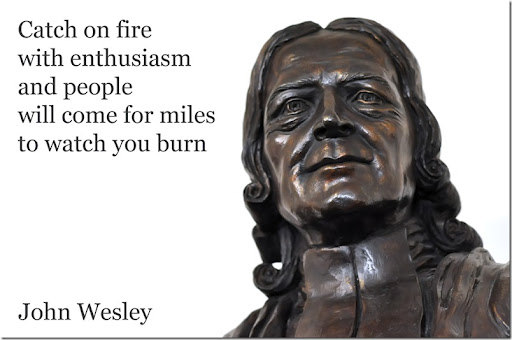
“Set yourself on fire with passion and people will come for miles to watch you burn.”

“In essentials, unity; in non-essentials, liberty; and in all things, charity.

“Be present at our table Lord. Be here and everywhere adored. Thy creatures bless and grant that we, may feast in paradise with Thee. Amen.”

People regularly attribute these four quotes to John Wesley. You may have seen them on t-shirts, printed on materials in your church, used them in your sermons, or tweeted them out.

Yet, none of them were written by John Wesley, and there is no record that he said any of them either.

Mis-quotes like these have great staying power. “Wesley’s Rule” (Do all the good you can…) was first attributed to John Wesley in 1904 and has found its way into quote books ever since.

The internet has only helped spread such mis-quotes further. Although we now have better access than ever to historical archives, the abundance of information online leads many of us to trust information that is repeated often and communicated by people we respect. The “set yourself on fire” quote is a particular favorite in the twittersphere due to its length, which is < 140 characters.  See the latest tweets and how they all seem to somehow modify this fake quote here.

The above information may make some of you feel the same way you did on the day when your elementary school friend told you that he saw his parents sneak into his room and place a half-dollar under his pillow after losing a tooth.

For consolation, I offer a word from a scholar who has spent his life debunking Wesley myths and providing the church and academy with new insights about the great man of faith.  Heitzenrater has written, “Many of the quotations cited to Wesley simply sound like something he might have said or written, rather than being something he actually expressed.”

See, even the expert cuts you some slack for believing them.

Mis-quotes like the ones above may not be true in the historical sense, but often they align with principles found throughout Wesley’s writings that we can apply to our world today.  Doing good, being full of passion for the gospel, exhibiting charity to others, and giving blessings for God’s gifts to us are all great things Wesley that Wesley promoted.

Even so, as I mentioned in the first post in this series, we must be wary of re-creating Wesley for our own purposes. Cherry picking quotes from his works—quotes that may be way out of context or even historically inaccurate—are a quick and easy way to fall into this trap.

Below is a portion of an interview I did with Richard Heitzenrater where we discussed his encounters with misinformation associated with Wesley. Here, he discusses some of the most common items he comes across and how he has handled such situations:

[Read more…] about Things John Wesley never said

June 1, 2012 by Jonathan 20 Comments

The Myth of the “Wesleyan Quadrilateral”

This is the first post in a new series: “John Wesley – The man, the myth, the legend “

If you’re a Methodist, you may have heard the phrase “Wesleyan Quadrilateral” thrown around.  It probably wasn’t dropped in the middle of a dinner conversation.  But perhaps your pastor has used it in the pulpit or a teacher mentioned to you that the “Wesleyan Quadrilateral” was a method you could use “to do theology”—aka reflection on things pertaining to God.

If you’re not a Methodist, you probably have not heard the phrase “Wesleyan Quadrilateral.”  But you probably have used this method to handle theological questions.

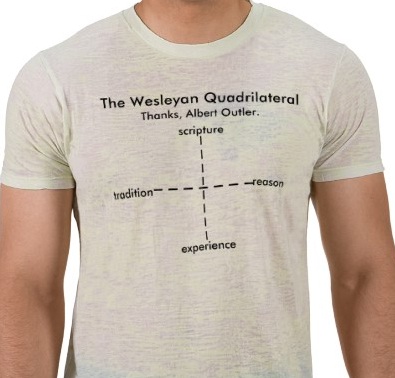
The “Wesleyan Quadrilateral” is best described by a line from the United Methodist Church’s (UMC) Book of Discipline where it states, “Wesley believed that the living core of the Christian faith was revealed in Scripture, illumined by tradition, vivified in personal experience, and confirmed by reason.”

Think about how you may have used this method.  Take the theological question, “As a Christian, is it okay to hurt someone I don’t like?”

To answer this, many Christians would first look to what the Bible says on the issue, for it is primary in any reflection relating to God.

They would then seek to understand what Christians throughout history have said.  Here, they would be looking at tradition.

Next, they would use reason to interpret the Bible, understand tradition, and infer implications where these things may be silent.

Finally, they would think of the question in terms of theirs and others experiences involving violence against people in their community.

This method has its flaws (see the sources section below the interview), but I believe it can be helpful as a basic framework.

However, this four-fold method is not John Wesley’s.  He never used the term “quadrilateral” or made a clear argument for the use of these four criteria.  Rather, the quadrilateral is a modern attempt to understand how Wesley went about doing his theology that many believe is a good model for the church.

These reasons lead me to think that perhaps we should stop attaching Wesley’s name to it.  Labeling it the UMC quadrilateral or the Albert Outler quadrilateral (after the scholar who formulated it) would be more accurate.

Another problem with attaching Wesley’s name to the quadrilateral is that it lends authority to a theological method that is often misused and misconstrued.  These misrepresentations ultimately  lead to a misrepresentation of Wesley and his beliefs.  Since its formulation, the quadrilateral has taken on a life of its own.  Its most egregious misuse occurs when people treat all four sources as being of equal authority, thus belittling scripture.

One day in my Methodism class a student mentioned the “Wesleyan Quadrilateral” to Wesley scholar Dr. Richard Heitzenrater.  He promptly responded, “Do you mean the Outler quadrilateral?  The quadrilateral is not John Wesley’s.”

Many people in the class sat stunned as a myth about Wesley that they believed all their life was busted by the man who first cracked the code of Wesley’s diaries.

Recently, I sat down with Dr. Heitzenrater for an interview about Wesleyan myths.  Below is the part of the interview regarding this moment in class:

[Read more…] about The Myth of the “Wesleyan Quadrilateral”

May 3, 2012 by Jonathan 54 Comments

New Series: John Wesley – The man, the myth, the legend

When the General Conference of the United Methodist Church comes around every four years, myths about John Wesley show up in full force.

Sometimes these myths show up on the swag handed out. Tote bags and t-shirts that include Wesley mis-quotes like “Catch on fire with enthusiasm and people will come for miles to watch you burn” have been around for decades.

Other times these myths show up in theological dialogue. Many United Methodist Churches defend the practice of inviting anyone, including people of other religions and those who are un-baptized, to the communion table by arguing that Wesley taught and practiced this same exact thing.

And still at other times Wesleyan myths are the basis for the whole conference, such as in 1996 when the theme was the quote by Wesley that has never been found in his works, “In Essentials Unity, In Non-Essentials, Liberty, In All Things Charity.”

As I’ve studied Methodism throughout seminary, I’ve found myself drawn to Wesley’s biography and writings. Reading primary and secondary sources surrounding this great man of the faith has proven edifying for my ministry and me.

Yet, in my studies of Wesley, I’ve noticed an unpleasant truth. It’s one that commonly surrounds historical figures—including the likes of Bonhoeffer, Martin Luther King Jr., and Jesus.

People love to re-create historical figures for their own purposes.

Re-creating figures in this way is very tempting. After all, what better way to justify or promote one’s own theological, political, or social agenda than to appeal to a historical figure that is beloved by all?

If the beloved historical figure is actually in agreement with what you’re advocating, then appealing to them is a strong strategy.

But if you’re stretching historical evidence, projecting modern questions and ideas into historical contexts, or simply parroting what others have told you about a great figure, then I think there are better ways to make your case.

I like to appeal to Wesley when working out my theology, so I’m often in danger of re-creating him in my theological likeness.

Re-creation can occur willfully or unknowingly. It may be done willfully by proof-texting random quotes from his writings that agree with me or by emphasizing aspects of his early theology I like even though I know he changed his beliefs on the issue later in life. It may be done unknowingly by simply perpetuating claims or quotes that other people have said about him.

Sometimes the perpetuation of Wesleyan myths is inconsequential. If it is in basic agreement with his theology and doctrine, does it really matter if Wesley didn’t actually say, “Do all the good you can, by all the means you can, in all the ways you can, in all the places you can, at all the times you can, to all the people you can, as long as ever you can”?

Other times the perpetuation of Wesleyan myths has great consequences. If the UMC is using Wesley as a main source of argument for certain theological beliefs and practices that he would be in disagreement with, the record should be set straight. Employing false church tradition in our thinking process is not helpful. Clearing the air of misinformation such as this enables the church to decide more faithfully what to think and do in today’s context.

In an upcoming blog series, I will explore some of the common myths surrounding Wesley. You may read some of the debunked myths and find them inconsequential. You may read some of the others and find them of great consequence. My goal in this series is not to crush sacred stories with a sledge hammer for academic fun. My goal is that as you learn more about Wesley you would cultivate a desire to study more about him for yourself.

This series will largely be based on a recent interview I did with Dr. Richard Heitzenrater. Dr. Heitzenrater is known for “breaking the code” of Wesley’s diaries that were written in shorthand. He is also regarded for giving these transcoded diaries as a gift to the church, serving as the General Editor of the Bicentennial Edition of the Works of John Wesley, authoring 16+ books, and chairing the Committee on Our Theological Task that wrote the present doctrinal statement in Part II of The Book of Discipline of the United Methodist Church.

I had the opportunity to study “The Life and Times of the Wesleys” under Dr. Heitzenrater last fall at Duke Divinity School. Throughout the class, I loved recording his anecdotes. Two of my favorites are “Anything since the 18th century is just current events” and “Almost every internet source is suspect.” The second quote should lead you to take even my words with a grain of salt.

Up first in this series is the myth held tightly and taught widely…. the myth of the “Wesleyan” quadrilateral.

Post 1: The Myth of the “Wesleyan Quadrilateral”

Post 2: Things John Wesley never said

What things about Wesley have you heard that you later found to be untrue? What things about Wesley are you still wondering about?


April 29, 2012 by Jonathan 9 Comments

  • « Go to Previous Page
  • Go to page 1
  • Go to page 2
  • Go to page 3

Copyright © 2026 · Atmosphere Pro on Genesis Framework · WordPress · Log in