• Skip to main content

Jonathan Andersen

A young pastor in an old denomination

  • About

Jonathan

Slowing Down

Things have been moving quickly lately. In the last nine months, I’ve gotten married, ordained, and sent to serve a new church–Harvest Point United Methodist Church in Locust Grove, Georgia. There’s been so much to celebrate and also so much to do!

Lately, I’ve been feeling God nudging me to slow down. And that’s when I stumbled on a beautiful and short documentary called Godspeed. This documentary follows Matt Canlis–a young pastor who wanted to achieve great things for the Kindom of God. But as he was preparing to graduate seminary, his mentor, Eugene Peterson, gave him some wise words that put him on a different path in life and in ministry.

Eugene Peterson told him, “Go somewhere where God might do something, but you won’t get any credit for it.”

So, he and his wife moved to Scotland and began to slow down. They began moving at God’s speed.

The documentary is 30 minutes, and while that might sound like a big chunk of time from your day, if you’re in ministry, it’ll be worth it.

February 3, 2018 by Jonathan 1 Comment

Preaching Without Notes: A New Habit to Transform Your Sermons

Seedbed.com recently started a new Preaching Collective. I’ll be a regular contributor there and wanted to share my first post with you!

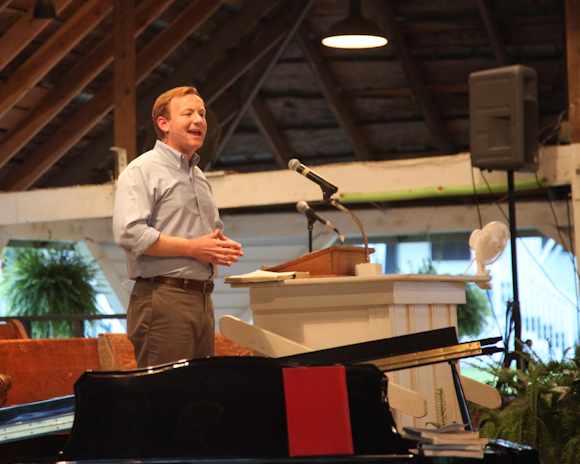
Smyrna Camp Meeting

“If you can learn to do this one thing, I guarantee you’ll get more responses from your sermons.”

When one of my mentors said this to me over coffee about a year ago, I listened intently. It sounded like he was about to tell me a closely guarded secret that people, including my seminary professors, had been keeping from me.

“Learn to preach without notes. It won’t necessarily lead to you preaching better content, but it will lead to a deeper connection.”

I thought about his words, admitted my fears, and committed to making it happen. After a year of preaching without notes, I’ve discovered he was right.

My sermons now connect with my congregation in a way they never did when I had my rehearsed manuscript. I receive more positive feedback than ever before. People often tell me what they’ve been thinking about the sermon weeks after I’ve preached it. And stories about people being “doers of the Word” are becoming more and more frequent.

My mentor didn’t give me a handy ten steps to learn how to preach without notes, but over the last year I’ve learned from many others who’ve made the journey before me. Here are the five most helpful things I’ve put into practice: 

1. Let connection take priority over precision

Most preachers are trained in seminary settings that prize precise language, perfect grammar, and phrases that read beautifully. But if you’re going to preach without notes, you have to be willing to sacrifice some precision of language for the sake of connection—unless you can memorize long form content verbatim on a weekly basis.

This doesn’t mean that you don’t do careful exegesis or commit certain phrases and transitions to memory. It does mean that you let eye contact and being fully present with the congregation take precedence over those sentences that took you hours to painstakingly craft in your study.

As Will Willimon recently wrote, “Even when we know our manuscript well, we tend to look at the manuscript rather than look at our listeners. We miss clues that our listeners are sending us when they don’t understand, or when they are losing interest.

2. Understand your sermon

Don’t try to memorize your sermon. It will be extremely difficult and probably leave you frustrated. Instead, simply understand your sermon. It’ll make preaching it without notes much easier.

Carey Nieuwhof puts it this way: “When you understand the structure of your talk, you understand your talk.” And when you understand your talk, you can stand in front of people without worrying that you’ll forget everything.

To help understand and remember the structure of my sermons, I often use structures popularized by others such as Andy Stanley’s Me, We, God, You, We or Paul Scott Wilson’s Four Pages of the Sermon. Other times, I create a structure unique to the text I’m preaching.

In all cases, I make an outline of the talk’s structure with as much detail as I feel I need for every point. When I started, I converted manuscripts to detailed outlines, and then converted those to simple outlines. Now, I start with a detailed outline to save time.

Before I step in front of the congregation, I make sure I can write down the structure of my sermon on a sheet of paper with no hesitancy. Then, even if I forget specific points or phrases, I know I can still convey the big picture.

3. Practice out loud on location

Most performers wouldn’t step on stage without having rehearsed what they’re going to say and do. Most preachers will.

If you want your sermons to stand out, the most effective thing you can do after understanding your sermon in your head is to hear it in your ears. Yes, I know it’s awkward. But it’s less awkward to discover that your sermon is too dense, has too many stories, or is it just plain bad while you’re alone than when you’re surrounded by a crowd of people.

Schedule practice time into your sermon preparation and try to rehearse in the room where you’ll be preaching. This will help you get a feel for the room, platform, lighting, and other elements.

Like Tim Ferriss does when he’s rehearsing public speaking, I’ll write down one-liners and phrases that I like so that I can remember them for later. And I continue going through my message until I nail it once.

You can read the last two points here.

July 30, 2015 by Jonathan Leave a Comment

14 Christmas Sermon Illustrations

Each Advent season, God invites us anew to reflect on the beauty of the incarnation—the mysterious act of the Word becoming flesh and dwelling among us.

Last year I featured 8 images that I found particularly powerful. I hope these additional illustrations will help you contemplate Christmas, complete a sermon, or come close to the feet of Jesus in worship again this year.

1. His Weakness as Our Virtue

He was a baby and a child, so that you may be a perfect human. He was wrapped in swaddling clothes, so that you may be freed from the snares of death. He was in a manger, so that you may be in the altar. He was on earth that you may be in the stars. He had no other place in the inn, so that you may have many mansions in the heavens. ‘He, being rich, became poor for your sakes, that through his poverty you might be rich.’ Therefore his poverty is our inheritance, and the Lord’s weakness is our virtue. He chose to lack for himself, that he may abound for all. The sobs of that appalling infancy cleanse me, those tears wash away my sins. – Ambrose of Milan, Exposition of the Gospel of Luke 2.41-42.

2. Salvation Happens in the Body

Bodies are central to the Christian story. Creation inaugurates bodies that are good, but the consequences of the fall are written on our bodies–our bodies will sweat as we labor in the fields, our bodies will hurt as we bear children, and, most centrally, our bodies will die. If the fall is written on the body, salvation happens in the body too. The kingdom of God is transmitted through Jesus’s body and is sustained in Christ’s Body, the church. Through the bodily suffering of Christ on the cross and the bodily resurrection of Christ from the dead, we are saved. Bodies are not just mirrors in which we see the consequence of the fall; they are also, in one theologian’s phrase, “where God has chosen to find us in our fallenness.” – Lauren Winner, Real Sex

3. The True Image of God

When we begin with a vague notion of what God is like we tend to project our own experiences, for better or worse, in formulating this image. … The secret to understanding who God is and consequently who we really are is to start with Jesus. The problem is that there are a lot of versions of Jesus out there. The only trustworthy way to understand Jesus is to study His Word with others in the power of the Holy Spirit. – Carolyn Moore, Encounter Jesus

You can find the rest of the illustrations in my guest post at Seedbed:
14 Christmas Sermon Illustrations


December 16, 2014 by Jonathan 1 Comment

5 reasons we need camp meetings now more than ever

Each summer I do something odd by most American standards: I spend one week with my extended family, we sleep in a crowded cabin with no air conditioner, and we go to worship services three times per day—alongside of hundreds of others—in an open air structure with a sawdust floor. The songs we sing were written long before I was born and the sermons last much longer than fifteen to eighteen minutes.

Each summer I go to camp meeting.

Salem Camp Meeting
Join me at Salem Campmeeting this summer: July 11th – 18th, 2014

Camp meetings are uniquely American institutions that were developed during the early years of the Second Great Awakening. At the time, they were a new method for evangelism and revival that sprang up all across the country. Camp meetings often provided a place for those who lived in unsettled areas to worship and gather as a community for a short period of time—typically during the late summer. They began with very temporary arrangements such as tents, wagons, and brush arbors to worship under. Over time, these gatherings established more permanent structures and began to draw people from all over the surrounding communities.

Francis Asbury once called camp meetings “a battle ax and weapon of war” that broke down walls of wickedness throughout America. He believed they were a great means of grace. And in 1811, he estimated that these spirit-filled gatherings brought together one-third of the total American population.

More than 200 years later, thousands of people continue to make the pilgrimage each summer to camp meetings that have withstood the test of time.

Here are five reasons why I think we still need them today:

1. They provide an opportunity for true Sabbath rest.

The first thing most people feel when they attend a camp meeting is that they have passed from busyness to tranquility in just a few small steps. Nestled away from billboards and rush hour traffic, part of the beauty of modern camp meetings is that most have literally been set apart from the world and inherited the simplicity of the times in which they were started.

You’ll rarely see a laptop, television, or gaming console. You’ll often see porch swings, laughter, and lounging. Many who attend take the week of camp meeting as vacation from work, and when no one else is worrying about being productive or efficient, you won’t feel the need to either.
The experience of camp meeting is difficult to describe, but Eugene Peterson’s description of Sabbath does a phenomenal job: “uncluttered time and space to distance ourselves from the frenzy of our own activities so we can see what God has been and is doing.”

2. They aid in the slow work of cultivating true community.

Today, the average worker stays in their job less than five years. The average homeowner sells their home in less than ten years. Sure, in five to ten years, great relationships can be built. But like cast iron skillets, the best relationships are formed slowly over time.

This summer will mark my 26th camp meeting. I’ve shared the crying years of infancy, the awkward years of middle school, and the growing years of being a young adult with an intergenerational community that hasn’t gone anywhere. Each year in this community babies are celebrated, deaths are mourned, people with cancer are cared for, and wayward children who once attended are lifted up in prayer.

Although I sleep in a cabin at camp meeting each night that holds three generations of my family, generations of others have helped them raise me and shape who I am. And they’re not all from the same church. As they were in the beginning, camp meetings continue to be a place where Methodists, Baptists, Presbyterians, and others truly come together for the gospel.

3. They are a foundation that helps with recalibration.

Questions like “who am I?,” “where am I headed?,” and “what’s the purpose of all of this?” aren’t anything new. Yet in a VUCA world—one that is volatile, uncertain, complex, and ambiguous—these questions are more challenging than ever and it’s easy to lose one’s bearings. Camp meetings are the antithesis of VUCA. Many of them are now 100+ years old and they exude steadiness, embody regular life-shaping rituals, and offer simplicity.

The altar calls, Sabbath time, and community that surround camp meetings provide just the kinds of opportunities through which one can easily explore the deep questions of life and experience the Holy Spirit move in a powerful way. They also come with the advantage that you can count on them every year.

J. Ellsworth Kalas once preached, “As marvelous as grace is when it invades our life, grace needs many continuing opportunities to invade our lives if we are to go on marching.” Camp meetings provide the time and place for this abundant grace to invade.

Click here to read the last two reasons on my guest post at Seedbed.com.

June 19, 2014 by Jonathan Leave a Comment

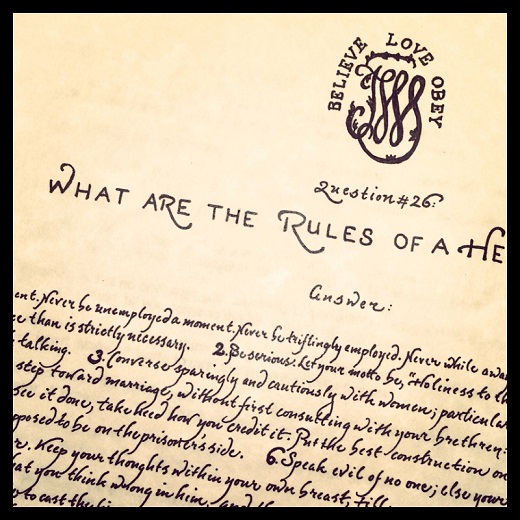
John Wesley’s 12 Rules for Preachers

Long ago when Methodism was still a movement, John Wesley gave his “helpers” a list of 12 rules to follow.

These “helpers” were lay preachers who were just starting to travel around and preach in various places.

I’m sure they were like many people just starting in ministry—hungry for guidance from those who had gone ahead of them, hoping not to make egregious mistakes with people’s souls, and excited about the mission that they were embarking upon.

Since my friends and I fit this same description two years ago when we were all graduating from seminary and being sent off to places around the country to preach, I decided to give them a list of Wesley’s 12 rules to hang in their offices. Of course, I made a copy for myself and it currently hangs on the “Wesley Wall” of my office.

I read over the rules regularly for basic guidance and to remind myself of the serious work to which I’ve been called. While I don’t take all of them literally (see rule number two:confession–sometimes I joke around), I’ve found them extremely helpful these last two years.

John_Wesley_12_Rules

May they guide you today:

Q. 26. What are the rules of a Helper?

1. Be diligent. Never be unemployed a moment. Never be triflingly employed. Never while away time; neither spend any more time at any place than is strictly necessary.

2. Be serious. Let your motto be, “Holiness to the Lord.” Avoid all lightness, jesting, and foolish talking.

3. Converse sparingly and cautiously with women; particularly, with young women.

4. Take no step toward marriage, without first consulting with your brethren.

5. Believe evil of no one; unless you see it done, take heed how you credit it. Put the best construction on every- thing. You know the Judge is always supposed to be on the prisoner’s side.

6. Speak evil of no one; else your word especially would eat as doth a canker. Keep your thoughts within your own breast, till you come to the person concerned.

7. Tell every one what you think wrong in him, and that plainly, as soon as may be; else it will fester in your heart. Make all haste to cast the fire out of your bosom.

8. Do not affect the gentleman. You have no more to do with this character than with that of a dancing-master. A Preacher of the gospel is the servant of all.

9. Be ashamed of nothing but sin: Not of fetching wood (if time permit) or drawing water; not of cleaning your own shoes, or your neighbour’s.

10. Be punctual. Do everything exactly at the time. And in general, do not mend our Rules, but keep them; not for wrath, but for conscience’ sake.

11. You have nothing to do but to save souls. Therefore spend and be spent in this work. And go always, not only to those that want you, but to those that want you most.

Observe: It is not your business to preach so many times, and to take care of this or that society; but to save as many souls as you can; to bring as many sinners as you possibly can to repentance, and with all your power to build them up in that holiness without which they cannot see the Lord. And remember! A Methodist Preacher is to mind every point, great and small, in the Methodist discipline! Therefore you will need all the sense you have, and to have all your wits about you!

12. Act in all things, not according to your own will, but as a son in the Gospel. As such, it is your part to employ your time in the manner which we direct; partly, in preaching and visiting from house to house; partly, in reading, meditation, and prayer. Above all, if you labour with us in our Lord’s vineyard, it is needful that you should do that part of the work which we advise, at those times and places which we judge most for his glory.

The copy I gave to my friends was one that I commissioned. My friend Nate Rauh did an amazing job writing the rules out in script and adding John Wesley’s seal to them. I’d like to share this work of art with you in case you’d like to print a copy for yourself.

You can download this beautiful PDF copy of John Wesley’s rules here.

May 7, 2014 by Jonathan 12 Comments

  • Go to page 1
  • Go to page 2
  • Go to page 3
  • Go to Next Page »

Copyright © 2026 · Atmosphere Pro on Genesis Framework · WordPress · Log in