• Skip to main content

Jonathan Andersen

A young pastor in an old denomination

  • About

Jonathan

What is a Methodist?

I’m teaching a course at my church called Methodism 101. 27 people signed up and have been attending regularly.

The first night of class I was shocked that 27 people–of all ages–signed up for a course on Methodism that had a boring name attached to it. But there they were.
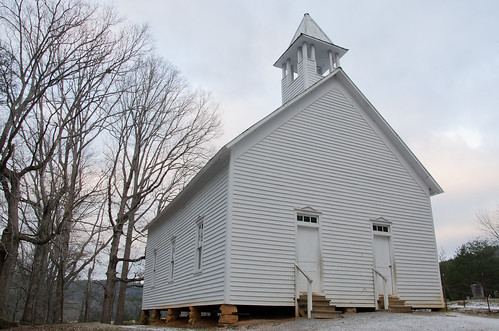
Cade's Cove Methodist Church
Cade’s Cove Methodist Church – Cade’s Cove, TN

Before we began, I asked them to answer one of two simple questions on a notecard: “What is a Methodist?” or “What makes the Methodist church distinctive from others?”

It’s a simple question that is difficult to answer. People have been trying for centuries, and I haven’t found a concise answer that I love–yet.

I don’t have my own answer worked out either, but I’m working on defining what a Methodist is as I prepare and teach this class each week.

I’d love to read your answer to one of the two questions in the comments below!

Below are the responses I received from the class:

  • A Methodist gives of themselves by helping others.
  • The only thing I know is that the Methodist cross has like fire, I think, on it. But I don’t know what it means.
  • It’s a mission church. It does more for the community and other places than any church I’ve been to. It makes you want to serve and volunteer.
  • A Methodist practices social Christian doctrine in each community.
  • Spiritual life intersects all areas of life and four factors are important – scripture, experience, reason and tradition.
  • The Methodist church follows the teachings of John Wesley.
  • It’s a body of believers in Christ that follows a “method” based on what someone’s activities were in college.
  • It’s a good mixture of formal (Episcopal) and informal worship.
  • I believe Methodism is a somewhat conservative religion (but less so than Baptist).
  • A denomination comprised of former Baptists, Catholics, some Jews, Presbyterians and even Methodists–all believing in Jesus Christ as our Lord and Savior.
  • It is a Christian church that is open to all, has open communion, and is mission oriented.
  • A Methodist will speak to you in a liquor store. We believe God is not waiting to punish but to love.
  • Of the beliefs I know, I agree with them. I attended both a Methodist and Catholic church for many years. My life is more meaningful being in a Methodist community.
  • The Methodist church believes that grace is given freely by God–does not have to be earned–and it accepts anyone who believes in Jesus.
  • We are open to all without prejudice(s).
  • It seems to me the Methodists are very accepting and welcoming of all.
  • The Methodist church follows principles and practices encouraged by John Wesley and other early leaders of the movement. It is open to anyone, very accepting, and diverse.
  • The Methodist churches I have attended seem less “official” than other denominations. They’re more laid back and accepting. They’re also less judgmental.
  • The open communion table separates Methodists from some of our Christian brothers.

You may have noticed some themes in these answers: mission oriented, John Wesley, openness to people of all Christian backgrounds, and welcoming.

What would you say?
January 28, 2014 by Jonathan 1 Comment

What’s your top income?

“There are few decisions that a young pastor or pastoral couple make that are more important than the attitude toward money. One should as early as possible determine the top income one would ever want or strive to have. Of course there has to be a degree of flexibility in such a decision, but the question of money and the dangers it poses should be kept under the closest scrutiny. Otherwise the desire ineluctably grows, avarice feeds upon itself, and one ends up as the victim of an appetite that is in fact insatiable and consumes by worry, guilt, and discontent in the hours and days that were once consecrated to ministry. It is not simply a matter of desire and avarice. The habits of a way of life become entrenched without our knowing it, and soon we discover that we have acquired all kinds of “needs” that can only be fed by more money.”

– Richard John Neuhaus, Freedom for Ministry


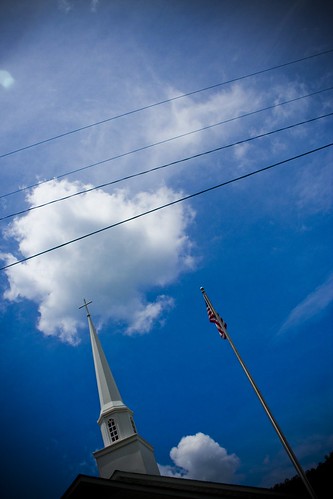
Steeple
Steeple by Kolin Toney

I came across this paragraph a few months back in a book that a friend recommended I read during my first year of ministry–Richard John Neuhaus’ Freedom for Ministry. The line in bold about one’s top income has haunted me ever since.

I’ve thought about the idea of setting a “top income” alot during the last few weeks–the time of the year when United Methodist pastors are up for appointment to different churches. In the itinerant model of ministry that the United Methodist Church (UMC) operates from, pastoral changes are ideally done so that the Church can best live out its mission: to make disciples of Jesus Christ for the transformation of the world.

However, as I’ve talked to friends in my own conference and throughout the country, a common concern is that the salary of a pastor plays too large of a role in the process of determining what church one serves.

Finding a solution to this problem at a denominational level is very complicated, and I’ve yet to hear many compelling ideas. Yet, Neuhaus’ quote reminds me that each pastor has the ability to be a part of the solution now.

What if pastors stopped striving to be at one of the “best” churches that could pay one of the largest salaries in their conference?

What if a pastor determined their “top income” and told their Bishop and District Superintendent that they were willing to go anywhere above this number–even if it meant a drastic pay cut?

What if a pastor was appointed to a church with a larger salary than their “top income” and then gave all the extra money away?

What if we as pastors encouraged everyone in our church to determine their top income as well?

All of these things might just help to reform our denomination, free us from our slavery to money, and enhance our witness to the good news of Jesus in this world.

Have you thought about setting a “top income”?
Do you have any ideas on how to reduce the prominence of salary in appointments?

———

If you’ve enjoyed this post, please feel free to subscribe to my email list so that you receive all of the latest content from the site:

April 21, 2013 by Jonathan 21 Comments

Ash Wednesday Sermon on Psalm 51 – The Truth About Ourselves

One fun thing about being a young preacher is that I have many “first” sermons: a first Christmas Eve sermon, a first sermon without notes, and many first sermons from different books of the bible.

Last week I had the opportunity for two first sermons: my first Ash Wednesday sermon and my first sermon to the congregation where I received my baptism, Conyers First United Methodist Church (UMC). While Jesus said, “no prophet is accepted in his hometown,” they accepted me and the challenging message of Ash Wednesday with open hearts.

My sermon was from one of the day’s lectionary passages, Psalm 51:1-17. I hope that it will both challenge and edify you. Audio/video of the sermon is available here.

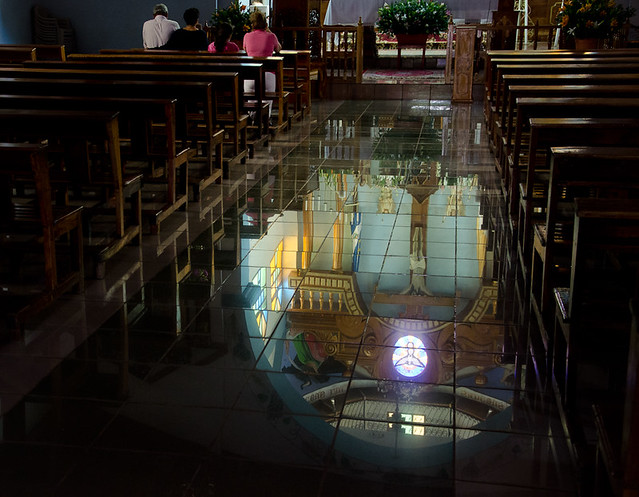
Iglesia en Ataco - Concepcion de Ataco, El Salvador
Concepcion de Ataco, El Salvador

The truth about ourselves

Some of you know that I majored in political science in college and worked on a political campaign just before I headed off to seminary. I’ve always enjoyed keeping up with politics. I love campaigns and elections. And while I rarely watch sports on television, I love following the always-changing nature of the political world through the news, debates, and the fast moving world of twitter. But like many of you, there are times when I get disillusioned and discouraged with the current political landscape. And the times I get most down about things are when I hear a non-apology apology from a politician.

Now I wasn’t aware that there was a proper title for these types of apologies until I began working on this sermon. And while you may not have heard of a non-apology apology before, I think you’ll know one when you hear it.

Here’s one that was offered by Congressman Joe Barton after he made a controversial statement about the government’s dealings with BP in the midst of the oil spill in the Gulf of Mexico a while back. Congressman Barton lamented, “If anything I have said this morning has been misconstrued to the opposite effect, I want to apologize for that misconstrued misconstruction.”

Or there’s this one from the chief of staff to President George H.W. Bush, John Sununu, after he was caught violating some White House travel rules. He stated, “Clearly, no one regrets more than I do the appearance of impropriety. Obviously, some mistakes were made.”

But as you probably know, non-apology apologies aren’t just limited to the political realm. When Janet Jackson’s wardrobe malfunctioned at the 2004 Super Bowl halftime show Justin Timberlake’s agent offered this apology, “I am sorry if anyone was offended by the wardrobe malfunction during the halftime performance.”

Scholars have even documented the common features of the non-apology apology and have defined a few characteristics that are common among them. First, they tend to offer a vague and incomplete acknowledgement of the offense. Second, they usually use phrases like, “I’m sorry that you were offended.” Third, they tend to minimize the offense. And finally they tend to question whether a victim has actually been harmed or damaged.

I don’t need to spend all this time explaining this phenomenon, because if you’re like myself, you’ve probably had decent practice forming these types of apologies yourself. “I didn’t mean to hurt anyone, but if I did…” “It’s regrettable that our relationship ended this way…” “I guess I was wrong.”

[Read more…] about Ash Wednesday Sermon on Psalm 51 – The Truth About Ourselves

February 20, 2013 by Jonathan 1 Comment

A prayer for the new year: Wesley’s Covenant Prayer

For countless years of my youth, I was at Conyers First United Methodist Church on New Year’s Eve.

Each year, the youth group at my home church hosted a lock-in on New Year’s Eve. These long nights were filled with lip-singing contests (I won many of these), games that involved us running through a huge dark church, pizza, and a pancake breakfast on New Year’s day. It seems like every year there was also a broken stained glass window discovered the Sunday after.

While vague memories of those fun times have lingered, I’ll never forget being in the sanctuary when the clock struck 12:00 each year.

We didn’t have a fancy service. We would gather in the sanctuary, which was always filled with a little more mystery without the sun-lit stained glass and loud organ present. Typically, we would sing worship songs played off of the latest WOW Worship CD. Our youth minister would give a short message. Then, we would sit in the pews and pray as the New Year arrived.

I don’t remember many specifics of my prayers on those evenings. But I always remember feeling the transcendent presence of God in the darkened space. I also remember asking myself this question each year: “Am I closer to God this year as compared to last year?” Some years this question was very convicting. Other years it led me to celebration.

Little did I nor the youth minister know that our gathering in the sanctuary on New Year’s Eve was a Methodist tradition that began years before.

In 1755, John Wesley began leading Covenant Renewal services. These services were times in which people would remember the covenant made at their baptism–a covenant to serve God with all one’s heart and soul. Wesley found that these services were very encouraging and powerful for everyone involved, and soon they began being held in numerous Methodist societies.

Over time, many British Methodist churches began to hold these services on New Year’s Day or the first Sunday of the year since these were natural times of renewing commitments. These services continue with regularity in British Methodism today. While only a small number of congregations in America hold these services each new year, the order of worship for a Covenant Renewal service can be found on page 288 of the UMC Book of Worship.

One of the most powerful aspects of the service is the “Wesley Covenant Prayer.” While John Wesley admitted that he was not the originator of this prayer, it has served as a powerful tool for spiritual formation in the Methodist church over the last two centuries.

Throughout my first six months of ministry I have prayed this prayer regularly in the mornings in order to help orient my heart for the day. I plan to continue to pray it throughout this new year, and I’d like to invite you to pray this prayer with me as well.

The Wesley Covenant Prayer

I am no longer my own, but thine.

Put me to what thou wilt, rank me with whom thou wilt.

Put me to doing, put me to suffering.

Let me be employed for thee or laid aside for thee,
exalted for thee or brought low for thee.

Let me be full, let me be empty.

Let me have all things, let me have nothing.

I freely and heartily yield all things to thy pleasure and disposal.

And now, O glorious and blessed God, Father, Son and Holy Spirit,
thou art mine, and I am thine.

So be it.

And the covenant which I have made on earth,
let it be ratified in heaven.

Amen.

Click here for a PDF of this prayer that you can easily print. This is a great prayer to have around, so cut it or fold it in half and place it in your bible or somewhere where you will see it regularly.


Kneeling

January 1, 2013 by Jonathan 4 Comments

A Christmas Sermon :: Light into Darkness

Yesterday was the first Christmas Eve that I spent away from my home church. While I was away from old friends and family, I was gathered with new friends and a new church family at Hamilton Mill United Methodist Church. There, I had the privilege of preaching my first ever Christmas Eve sermon at our 11:00 Candlelight Communion service. I hope that my message based on John 1:1-14 will bless you this Christmas day.

For more Christmas eve sermon material, you can find 14 Christmas Sermon Illustrations on my blog as well.

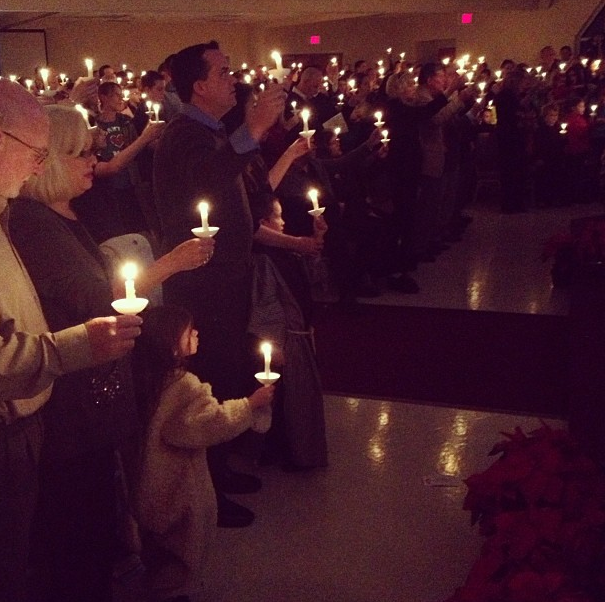
Candle Light at HMUMC

Light into Darkness

All of us celebrate Christmas in our own special way. For 15 or so years of my life, my whole family traveled from Conyers to Buckhead, unloaded at Phipps Plaza, and then waited in line together so that my brothers and I could tell Santa what we wanted for Christmas. One of my friend’s families goes and eats at the Varsity before heading to church every Christmas eve. This eleven o’clock service, a service that is truly set on a silent night when few cars roam the streets, may be a Christmas tradition for you. And tomorrow is when most of the celebration happens. Some houses have gifts waiting by the chimney from Santa, other houses only have a few gifts but they have lots of laughter and long conversations. Many of you will take naps, I’ll likely go see a movie in the evening, and one member of the church told me that on Christmas night her and her family go to Hooters for fried pickles and wings. We really all do remember the day of Christmas in our own special ways.

And the gospel writers are no different than we are. As they wrote biographies, stories that attempted to showcase the identity and significance of Jesus, they each remembered Christmas – the day that Jesus entered this world – in their own special ways.

Matthew tells us about Joseph who was visited by an angel who informed him about the son his wife was going to give birth to, and he tells us about the Magi who recognized the baby Jesus as King of the Jews once he was born.

Mark’s gospel actually doesn’t mention anything about Jesus’ birth. Instead, he begins his story about Jesus with John the Baptist — Jesus’ cousin who prepared the way for him by preaching a baptism of repentance for the forgiveness of sins.

Luke gives us the classic Christmas story that I’ve acted out in many pageants, and you’ve likely heard, many times before. Luke tells of angels visiting Mary and her sister Elizabeth letting them know that they’re going to bear children. Then he tells us—you probably know the King James Version of this line — “It came to pass in those days, that there went out a decree from Caesar Augustus that all the world should be taxed.” And we hear how there was no room for Mary and Joseph in Bethlehem so they gave birth to Jesus and placed him in a manger. And who can forget the shepherds who heard the great news of the Savior’s birth while they were abiding in the fields, keeping watch over their flocks by night.

And then there comes John’s gospel which we heard a few minutes ago. He doesn’t mention angels, shepherds, Mary, Joseph, or wise men. John assumes that we already know those stories. And instead of retelling them from his perspective, he gives us an introduction to his story about Jesus that is full of poetry, images, and metaphors. And all of them help summarize the significance of Jesus’ mission and entrance into the world.

And it’s the apostle John who gives us one of the clearest images of what Christmas is all about. It’s an image that has its roots in Old Testament prophecies. It’s an image that Jesus himself used to describe his mission. It’s an image that we celebrated earlier this evening with the lighting of the Christ candle. And it’s an image of the good news that we will walk out of here remembering and proclaiming tonight.

John reminds us that at Christmas, we celebrate that Jesus is the light of the world who came to extinguish all darkness.

John’s introduction to his gospel helps us understand this image. He starts off with the same words that begin Genesis, “In the beginning….”

But instead of giving us a detailed account of how the world came into being, John tells us this: In the beginning was the Word. Now, the Word may be thought of as “the active agent through whom God created the world.” [Oden, 255] And John continues by telling us that this Word was with God in the beginning, and the Word was God. All things came into being through him, and without him not one thing came into being. What has come into being in him was life, and the life was the light of all people.

Here, in this poetic language John points us to one of the deepest mysteries of the Christian faith: the Trinity—the reality that there is one God made up of Father, Son, and Holy Spirit, and that all of three of these persons have existed for all time. And here in in the opening sentences of his biography of Jesus, John reminds us that Jesus was present at creation, he isn’t merely a man who had a humble birth in a stable. Jesus is God.

And it was at creation that Jesus gave light and life to all people, for even at that time, he was the light of the world. And in the beginning, the world was full of life, it was full of light. God the Father through Jesus created humanity in his image so that we could be in relationship with him. He made us stewards over all of creation. And he created us to be in relationship with other people. Everything was good and full of light.

If the story stopped there, we wouldn’t be here celebrating Jesus’ birth today. We know that everything didn’t remain as God created it. Instead, Adam and Eve broke relationship with God when they disobeyed him. Immediately, they knew that what they had done was not right, so they went and hid in the darkness so that they wouldn’t have to face God. But God sought them out because he didn’t want them to be in the shadows, living in darkness. He told them that he loved him, and ever since then he has been trying to have his children live in the light rather than the darkness. But humans have continued to separate themselves from the light of God. We have exchanged our relationship with God for relationships with idols, we have not been good stewards of creation, and we have not loved those around us. We have chosen to separate ourselves from the light God gave us, and instead live in darkness.

For thousands of years God tried to help his people move back into the light. He gave the people of Israel light through the law and through his covenant promises, but they continued to live in darkness and disobedience. So through the prophets he promised his people a Messiah, a Savior, a liberator who would shine light into the darkness and enable people to walk in light.

And in the fullness of time, God sent his only son Jesus into the world to fulfill these roles. On the very first Christmas day, Jesus was born into a world of darkness so that he could bring an end to darkness. And the darkness was thick. The first Christmas wasn’t as peaceful as Hallmark cards often depict it. Soon after he was born, King Herod murdered all the babies who were two years old and under in the region in hopes that he would kill baby Jesus in the process. Caesar Augustus, the Roman Emperor during Jesus’ day regularly beat groups of people who opposed his rule into submission. Throughout his ministry, Jesus was ridiculed, questioned, and hated by many of his own Jewish brothers and sisters. But none of this stopped him from completing the mission he came to fulfill.

Jesus was God present as a man in the world. He was a prophet who revealed to humanity how we could live alongside of one another and love each other. He was a friend to the outcasts of society—the women, the prisoners, the hungry, the lepers, and all those who were deemed sinners by others. He was the light of the world shining light into the darkness. But as John tells us, when Jesus was in the world many of his own people who were living in darkness did not accept him. They didn’t want to receive light. So they crucified Jesus on a cross hoping to extinguish the light he radiated once and for all.

But God had other plans. God lovingly used Jesus’ death on the cross as an all-sufficient sacrifice that was owed to him because of humanity’s sin. This provided a way for the darkness of sin to be extinguished from the world. And three days after he died, Jesus conquered the darkness of death by rising from the grave. He ascended into heaven from where he originally came, and now he reigns there over his kingdom.

This is the story of the world that the church believes and teaches, but it isn’t always clear where we fit into this story and how it continues today.

Connecting Our Story to God’s Story

At times we’re tempted to think that everything is now okay in the world, that people are basically good, that things are a lot better along than they have been throughout history, and that perhaps if we all just tried to be a little nicer to each other, then this world would be as good as it can be.

But then someone walks into an elementary school with a gun and murders twenty-six people who were looking forward with excitement to Christmas break. Your spouse tells you that they don’t think they can continue in the marriage anymore. Your father dies. A friend talks about you behind your back. You find out that your child is addicted to drugs. Or maybe you wake up one day and realize that you’re addicted to something. Or you begin to hate yourself because of regrets that lie in your past.

It’s in those moments that we know that everything isn’t okay in the world. We know that darkness is still present. And we’re left wondering how these things happen in the world even after Jesus, the prince of peace, entered it at Christmas.

A Dark Prison Cell

I think a metaphor from Dietrich Bonhoeffer may be helpful here. Bonhoeffer was a Lutheran pastor who was arrested during World War II because of his resistance to Hitler’s regime. While many church leaders in Germany gave in to Hitler and went along with him, Bonhoeffer stood strong with only a few others.  He was also an amazing theologian who left behind many writings, some of which are his letters from prison written to those on the outside.

In a letter dated November 21, 1943 Bonhoeffer wrote, “Life in a prison cell may well be compared to Advent: one waits, hopes, and does this, that, or the other—things that are really of no consequence—the door is shut, and can only be opened from the outside.” [Bonhoeffer, God is in the Manger]

Life in a dark prison cell. I think that this is a great way to think about the situation of humanity. Before Jesus came there was only a sliver of light entering the cell through the bottom of the door. People were living in great darkness without the possibility of escape. But then one day, Christmas day, the door was opened from the outside, Jesus came into the cell. He lived with those inside in the midst of their darkness. He told them about a new world that was outside that they could experience if they would only follow him out the door. He told them that it was infinitely better than anything they’d experienced up until that point.

Some listened and trusted him. But others kicked him out of the cell. They were used to the darkness and were content with it. They had become so used to living in the cell that they couldn’t imagine anything better awaited them elsewhere.

After Jesus was kicked out of the cell some of the people who trusted him followed the path to the way out. These followers of Jesus discovered a new world outside of the darkness of the cell—a world full of light, peace, love, faith, hope, and joy. And so they ran back into the cell to tell others the good news. They told the others inside that they should trust the Jesus guy who came and opened the cell and follow his path out the door into the light. They were witnesses to the light and the amazing new life that came along with it. And while many people did follow them out, many chose to remain in the dark cell – a cell that they had grown used to, a cell that their eyes had adjusted to.

This cell is like the world we continue to live in, and the church is that body of messengers who constantly return to the cell by the power of the Holy Spirit to let others know that they can be free from darkness because of God’s great gift to them.

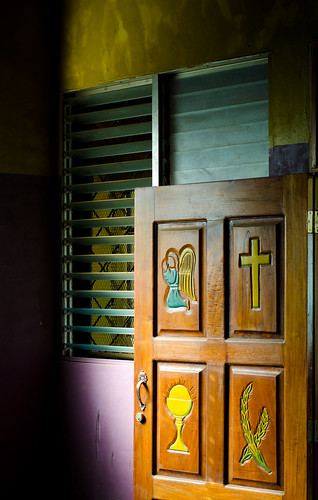
The door of light & life

Our Response

Today we celebrate that God did not leave us in the dark cell but sent his only Son to come identity with us and our situation, and show us the way towards light and new life. And we also look with great expectation to the day in which Jesus will come again in this world and complete his work of extinguishing all darkness, for we know that the darkness will never be able to overcome the light.

John tells us the way out of the cell. John tells us that all who receive Jesus—all who believe that he is the Christ, the Son of God, the light of the world sent to save us from our sins—all those who believe will receive the forgiveness of sins, the power to become children of God, and the assurance of life forever with God.

This is the good news of Christmas.

And if you haven’t ever believed in Jesus as the Savior of this world and the Savior of your life, then there is no better time than on this day in which we celebrate his entrance into our world.

And if you have believed in Jesus and followed him to light and new life, then tonight you have the opportunity to ask God to search your heart, reveal to you the darkness that still resides there, and to send his Holy Spirit to fill it with light. And you also have a mission. You’re called to go and tell others about the light of the world and the freedom he brings. You’re called to carry the light of Christ into the world so that others may receive the greatest gift on earth.

The Table

I don’t know if you’ve ever met some of the men from Phillip’s Transitional Center who are on their way out of the prison system. They’re in a transitional program so many of them are allowed to work and attend church, but they must go back and sleep behind bars each night. Since I’ve been here, we’ve had the amazing privilege at our 8:15 service of celebrating with a few of these guys who are set to be released within just a few days. Many of them are filled with a nervous excitement—they’re nervous about what life will be like on the outside and excited about their new freedom. They usually have huge smiles on their faces when we stand up and celebrate them in worship. And one of the first things I know they do when they get home is to go share a meal with their family and friends celebrating their new life.

Well, tonight, we have the opportunity to share a meal around this table with family and friends. We have the opportunity to celebrate with joy the new life we have because the Word decided to take on flesh and set us free from darkness. My prayer for you this Christmas Eve is that Christ would come into each of your lives in a new way as we gather around his table and that you would depart from this place carrying light into a world that so desperately needs it.

In the name of the Father, Son, and Holy Spirit. Amen.

You may also enjoy: 14 Christmas Sermon Illustrations

December 25, 2012 by Jonathan 9 Comments

  • « Go to Previous Page
  • Go to page 1
  • Go to page 2
  • Go to page 3
  • Go to Next Page »

Copyright © 2026 · Atmosphere Pro on Genesis Framework · WordPress · Log in